
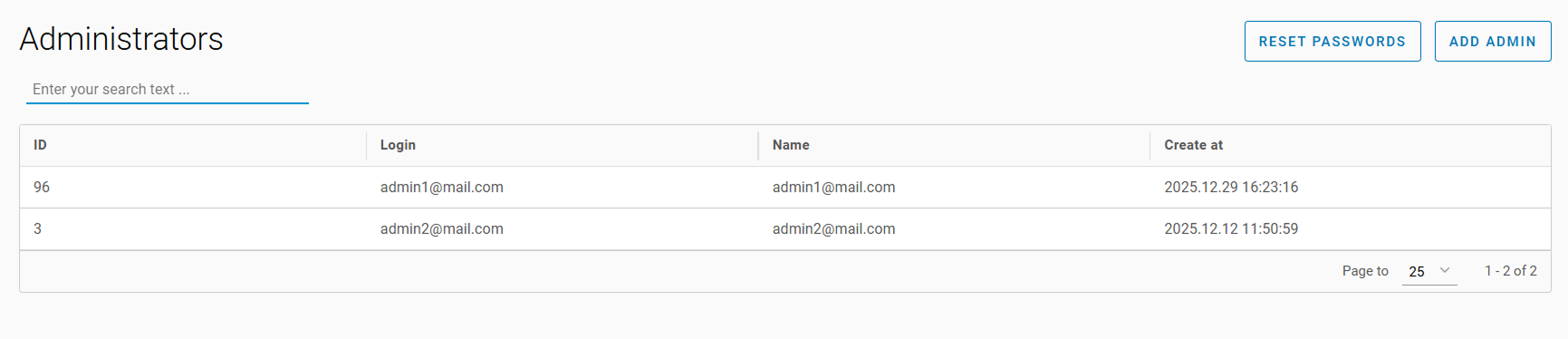
The Administrators section lists the administrators who manage the system.
You can search for an administrator by login or name.
On this page, you can perform the following actions:
-
Create an administrator account.
-
View, edit, and delete existing administrator accounts.
-
Mass password reset for administrator accounts.
Mass password reset
For centralized password management, the Reset passwords button is available at the top‑right corner of the Administrators page. This button enables simultaneous password resets for all administrator accounts, excluding the one initiating the action.
Visibility of the Reset passwords button is controlled by the permission Administrators > Reset administrator passwords.
Password reset behavior:
-
After a password reset, administrators are redirected to the login page to enter a new password.
-
If any administrators are logged in at the time of the reset, they are forcibly signed out and redirected to the login page to re‑authenticate.
Add an administrator account
To create a new administrator account, follow the steps:
-
Select the Add Admin button.
-
On the page that opens:
-
Enter a full name, login, and password.
-
The Password lifetime toggle allows setting a password expiration period in days. When managing an administrator account, you can update the setting from the Change password tab.
-
In the Role section, you can assign roles to the administrator. The field is optional. Role is a preset collection of permissions. Roles are configured in the Administrator roles section. Role behavior: Selecting a role automatically enables its permissions in Access levels, which can then be fine‑tuned manually by the administrator. When multiple roles are selected, all permissions included in those roles are automatically enabled. For example, if a Cameras role is created for camera access only and an Intercoms role for intercom access only, selecting both will grant the administrator access to both systems.
-
Under Access levels, select permissions to specific functions.
-
Under Cameras for administration, configure access to cameras, intercoms, and media server groups in the relevant sections:
-
Available cameras lists top-level branches of the camera tree. Access is managed at the branch level – selecting a specific branch automatically grants permissions for all cameras nested within that hierarchy. For details on the camera tree management, see the Custom tree view documentation page.
-
Available intercoms lists top-level branches of the intercom tree. Access is managed at the branch level – selecting a specific branch automatically grants permissions for all intercoms nested within that hierarchy. For details on the camera tree management, see the Intercom tree view documentation page.
-
Available MSE groups lists the mediaserver groups. Selecting a specific group automatically grants permissions for all mediaservers nested in it. For details on how to manage mediaserver groups, refer to the Mediaserver groups documentation page.
-
The description of Available MSE groups functionality is provided below.
-
Select the Create button.
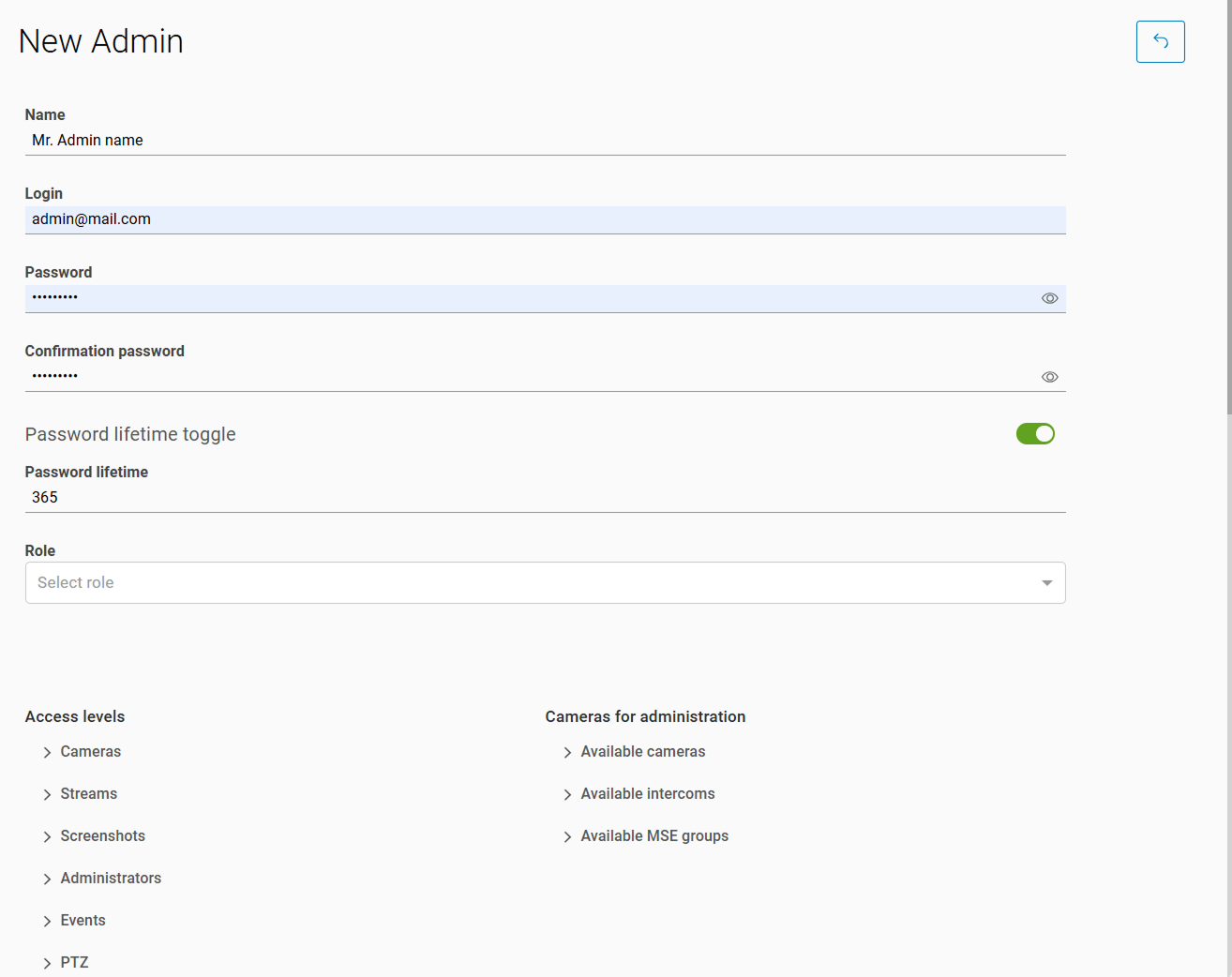
Once the account is saved, the assigned role isn’t displayed in the Role field.
View administrator information
To view information about an administrator, open the Administrators list and select the respective row in the table.
As a result, details will be displayed grouped on the following tabs:
-
On the General information tab, you can edit a name, login, role, access level, and cameras for administration.
-
On the Change password tab, you can manage a password and its expiration.
-
On DHCP Groups tab, you can manage DHCP pool groups for the administrator.
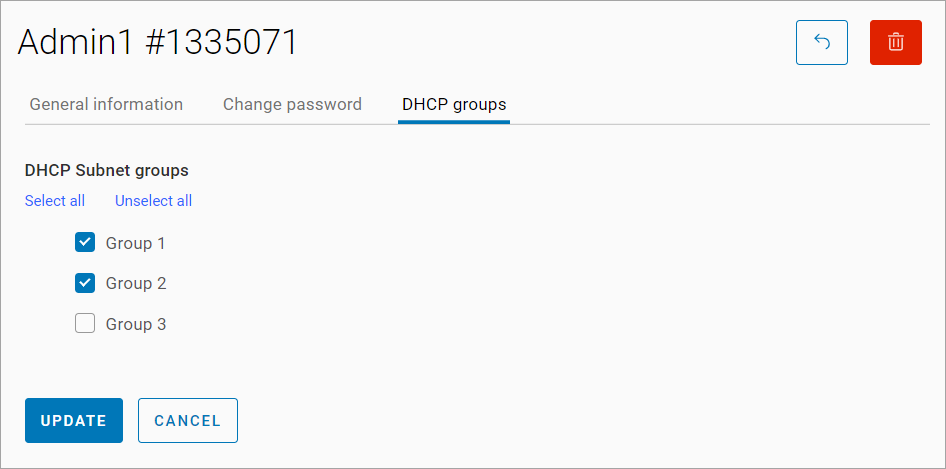
The selection of DHCP pool groups can also be assigned when managing a DHCP pool group. For details, refer to the DHCP subnet groups section.
Access to mediaservers
If an administrator is granted one or more mediaserver groups, they gain the following rights:
-
Access to all clusters included in the group
-
Access to all mediaservers within those clusters
-
Access to standalone mediaservers not included in any cluster
-
Access to standalone mediaservers not linked to groups or clusters
-
Access to standalone clusters not associated with any group
If no mediaserver groups are assigned, the administrator is granted the following rights:
-
Access to standalone mediaservers not included in clusters
-
Access to standalone mediaservers not linked to groups or clusters
-
Access to standalone clusters not associated with any group
|
Sections in the Administrator client |
System behavior |
|---|---|
|
Camera details card |
The General data tab. No camera streams are added. The Media Server groups drop-down supports selection of the groups that this administrator has access to. |
|
The Video Streams tab: the process of adding streams. The camera isn’t assigned to a mediaserver group:
i. Subnets are configured within mediaserver groups. a. The camera IP address is within the distribution range of mediaservers accessible to the administrator:
b. The camera IP address is within the distribution range of mediaservers that isn’t accessible to the administrator:
ii. Subnets aren’t configured within mediaserver groups.
The camera is assigned to a mediaserver group:
i. Subnets are configured within mediaserver groups.
ii. Subnets aren’t configured within mediaserver groups.
|
|
|
The Video streams tab. Stream information display for a camera added by a different administrator. If the administrator has access to view a camera but doesn’t have access to the mediaserver hosting its streams, only the address of that mediaserver is displayed. When the administrator attempts to view information about this mediaserver, a page opens with the message: Access to the mediaserver is restricted. Transfer of streams. Subnets are configured within mediaserver groups:
Subnets aren’t configured within mediaserver groups:
|
|
|
Cameras section > Incorrect cameras subsection |
On the Incorrect, Problematic, and Disconnected tabs, the administrator can view cameras that they have access to. If those cameras are hosted on a mediaserver the administrator cannot access, only the server address is displayed, without the option to view its settings. |
|
Cameras section > Statistics subsection |
The page lists mediaservers available to the administrator. Accessible servers are defined as follows:
Search is performed only among media servers available to the administrator. |
|
Provisioning section > Media Servers subsection |
|
|
Provisioning section > Media Servers Clusters subsection |
The following clusters are displayed:
During cluster creation or viewing, only media servers accessible to the administrator are listed.
|
|
Administration section > Administrators subsection |
During creation or viewing of an administrator account, only mediaserver groups are listed that the administrator can access. |
|
Analytics section > Analytics module subsection |
The list shows mediaserver groups the administrator can access. They are listed:
|
|
Report section > Report on channels load of the mediaserevers |
The downloaded report includes only mediaservers and clusters that the administrator has access to. |
|
Report section > Report on load of the mediaserevers |
The downloaded report includes:
|
|
Report section > Report on Cameras |
When choosing parameters for generating the report based on Mediaservers, the filters will contain:
The downloaded report:
|
|
Report section > Report on Mediaservers |
The downloaded report includes:
|
|
Report section > Report on inactive servers |
The downloaded report includes:
|
|
Report section > Report on system |
The downloaded report includes the total number of mediaservers added to the system, regardless of administrator restrictions. |
|
Report section > Report on system events |
The downloaded report includes events related to the mediaservers the administrator has access to. |
|
Logging section > Events subsection |
On the System events tab > Media servers subtab lists events related to the mediaservers the administrator has access to. |
|
Dashboard |
The Dashboard contains information related to the mediaservers included into groups the administrator has access to. |